Outdoor Handrails for Steps: Selection and Feasibility
Outdoor handrails for steps need the same decisions as any railing: a graspable profile, a guard where the drop calls for one, and fixings suited to the substrate. George reviews buyer drawings and confirms feasibility for each flight.
Request a quote for this design
- George Group established
- 2006
- Showroom
- 10,000 square meters
- Countries served
- 100+
Specifying Outdoor Handrails on Step Flights
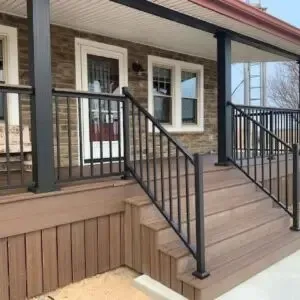
A graspable handrail is the element a hand closes around while climbing; a guard is the barrier that stops people falling from an open edge. A flight may need one, the other or both, and the project’s designer and the local authority having jurisdiction decide which. For outdoor handrails for steps, the first task is to record step rise and going, flight width and riser count, the fixing substrate, and the exposure the railing will face — driven rain, salt air, frost or strong sun.
- Rise and going of each step, plus the total flight width
- Substrate at every post: concrete, masonry, steel or timber
- Exposure: rain, salt air, frost, sun and how the rail will be cleaned
- Finish direction, and whether a guard is also needed beside the flight
Metal-mounted and concrete-mounted sections are reviewed separately, because anchorage differs. George supplies custom staircases and railings made to buyers’ drawings; the sales team clarifies needs and budget before giving a rough quotation, and feasibility is confirmed against the drawings there. Buyers send drawings or photos with dimensions, materials and quantity. Handrails for stairs covers the wider range.
Handrail Selection for Outdoor Steps
Decide where the rail starts and ends, whether it turns around a landing, and whether the flight also needs a guard. Material and finish follow the exposure — powder-coated aluminum and marine-grade stainless steel (316) resist rust, moisture and fluctuating weather. George confirms feasibility for each design against the buyer’s drawings in the quotation. Related reading: metal handrails for steps.
Concrete-Mounted Handrails
Outdoor handrails for concrete steps depend on what the concrete can accept. Note the slab or step thickness, whether the concrete is reinforced, the intended post spacing, and the edge distance from each fixing to the nearest face; a designer or structural engineer then reviews anchorage for the loads the railing must resist. Cast-in anchors, resin anchors and surface plates behave differently. George reviews drawings for concrete-mounted sections and confirms feasibility in the quotation. See the wider staircase railing range for matching posts and infill.
Wooden Handrail Options
Wooden handrails for outdoor steps suit traditional and rustic settings, and species choice matters: dense, rot-resistant timbers hold up better than softwoods, and end grain needs sealing at every cut. Oils, stains and film finishes each need re-application over time, so record the maintenance the owner will accept. Fixing details also decide the result — timber posts on metal bases, brackets into masonry, or rails fixed to the stringer. George supplies custom handrail tubes in wood among other materials and confirms wood feasibility to the drawings.
Aluminum Handrail Options
Aluminum handrails for outdoor steps are chosen for weight and weather resistance; aluminum is lighter than steel and corrosion-resistant, which suits outdoor use. Square profiles such as 1.5”x1.5” and rectangles such as 2”x1” or 2”x0.5” are common shapes for a slim rail. Powder coating adds colour and a further layer against moisture, while a mill finish is left bare. Fixing follows the substrate — surface plates on concrete, brackets on timber. George reviews aluminum requirements against drawings and confirms feasibility in the quotation.
Iron Handrail Options
Iron handrails for outdoor steps bring a heavier, forged look. A wrought iron stair handrail or coated metal stair handrail adds an industrial aesthetic to a project. Profiles commonly run around 1.5”x1” or 1.5’’ x 1.5’’, often in flat black over a protective coating. Iron rusts where the coating is damaged, so the finish system, the touch-up approach and the way posts are fixed to concrete or timber should be settled early. George confirms feasibility for iron and coated metal designs from buyer drawings in the quotation.
Short Two-Step Outdoor Handrail
A short outdoor flight still needs the guard-versus-handrail decision. Where the drop beside the steps is low, a handrail alone may be what the designer specifies; where there is an open edge, a guard may also be needed. Local rules settle the height, the size of openings and the anchorage the short posts must achieve, and the designer and the authority having jurisdiction interpret them. George reviews short-flight drawings and confirms feasibility in the quotation, using the same drawing-based process as longer flights.
Wrought Iron Handrail Options
Wrought iron handrails for outdoor steps are specified by profile, ornament and finish. Common shapes include a 1.5’’ x 1.5’’ hammered profile, a 1.5’’ rail with an engraved volute end, and a 1.5”x1” hammered engraved rail, usually in flat black. Volutes, scrolls and hammered texture are chosen for the style of the building, and the finish system should be agreed before production. Fixing to concrete, masonry or timber changes the post detail. George reviews wrought iron drawings and confirms feasibility; wrought iron railing shows related work.
Rope Handrail Outdoor Note
Rope is often used outdoors as decorative infill or a rustic rail, but a rope span deflects under load and does not give the firm, continuous grip a graspable handrail is expected to provide. Whether rope can serve as the handrail itself depends on local rules, and that question goes to the authority having jurisdiction rather than to the supplier. Where a firm grip is needed, a metal or timber rail alongside the rope is the practical route. George reviews the drawings and quotes an option the buyer’s reviewer can assess.
From Drawing to Delivered Railing
George Design & Construction Co., Ltd. is a one-stop building materials supplier in China. George Group was established in 2006 and is based in Foshan, China. The company has a 10,000-square-meter showroom and has served 100+ countries. Railing enquiries start with drawings or photos, dimensions, materials, finish and quantity, and move to a quotation before production begins.
Components for custom straight staircases are numbered and shipped with a detailed installation guide, and there is no minimum order quantity for custom straight staircases. Payment and delivery terms are confirmed in the quotation.
How an order runs
- Send your project details
- Drawings or reference photos, floor-to-floor height or run length, the materials and finish you prefer, the quantity and the delivery country.
- Needs, budget and rough quotation
- For customized stairs, the George sales team first clarifies your needs and budget before giving a rough quotation.
- Drawings and material selection
- Design details and materials are agreed on the drawings before production starts.
- Production time
- Typical production time for a custom staircase is 4–8 weeks, depending on the complexity of the design.
- Quality checks
- The George quality control team checks materials and products through production and loading.
- Payment and delivery terms
- Payment and delivery terms are confirmed in the quotation.
Request a quotation
Send your drawings or reference photos, the dimensions, the materials and finish, the quantity and the delivery country.
Or write to sales@staircasesupplier.com