Outdoor stair treads: choosing material, grip and drainage
Exterior steps have to shed water, grip a wet shoe and survive frost. Material, surface texture, drainage and fixing decide whether outdoor stair treads do that, and buyers set those points out on the drawings that George prices.
Request a quote for this design
- George Group established
- 2006
- Showroom
- 10,000 square meters
- Countries served
- 100+
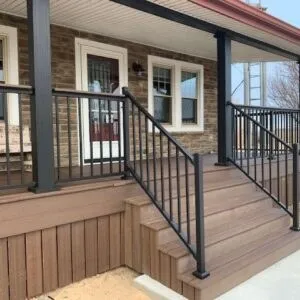
Material, grip and drainage: what an exterior stair tread has to do
Treads are the part of the staircase where every step counts, and outdoors they must resist water and frost, hold grip when wet, and let water leave the flight. Solid wood, stone, glass and metal are the common tread materials, each answering those demands differently. A smooth, closed face on a rainy elevation is the usual cause of a slippery step; a textured face with a slight fall to the outside is the usual answer.
George Group was established in 2006. George supplies custom staircases and railings to buyers’ drawings from Foshan. George’s sales team first clarifies the buyer’s needs and budget before giving a rough quotation, and confirms which treads it can produce in the chosen material, thickness and edge detail. Surface options are compared on stair treads and non-slip stair treads.
Metal treads for outdoor stairs
Metal treads for outdoor stairs are specified by the form of the metal rather than by a species: plate thickness, or grating size and bar spacing. A galvanised grating tread can be called out as 11-3/4” x 2” x 14GA or 9-1/2” x 2” x 14GA, and bar grating can use 1” x 3/16” rectangular bars with a serrated face and 77% open area.
Folded plate gives a closed walking face with returns at the front and sides, which stiffens the tread and keeps the nosing line crisp; perforated plate does the same with holes. Fixings are normally bolts or welds to the stringer. The tread type, gauge and finish for a project are confirmed against the drawings when George prices the stair.
Heated treads: what is involved and what to confirm
A heated tread carries an element set under or within the walking surface, such as a cable mat, a film or a low-voltage element, wired back to a supply and a control. The tread has to be thick enough for the element and the covering above it, and the covering has to pass heat without cracking or lifting at the edges.
Supply, switching and control position are settled at design stage, because the cable route follows the stair structure. Isolation, protection and earthing belong to a qualified electrician working to local regulations.
Winter grip, drainage and clearing
In winter the surface does the work. A textured, serrated, grooved or perforated tread holds a boot on wet timber, wet stone or melting snow better than a smooth one, and a grating lets meltwater run through. Falls matter as much as texture: a slope across the tread, a gap at the back and open risers all stop water sitting where tread meets stringer.
Clearing belongs in the design brief. A flight that sweeps from the bottom up, with room to stand at each end, is easier to keep clear than one ending against a wall, and a grating tread clears with a broom. The final surface is confirmed with George at quotation against the drawings and the site conditions described.
Exterior metal tread finish and fixing
Finish decides how long an outdoor metal tread lasts. Galvanised steel takes weather and abrasion and can be left bare or powder-coated over; an exterior powder coat needs specifying for exposure, with cut edges and bolt holes in mind. Aluminium is lighter than steel and corrosion-resistant, which suits indoor and outdoor applications, and stainless steel suits salt-exposed sites.
Fixing details decide whether water stands at the joint. A tread that returns over the stringer sheds water better than one resting on a flat shelf. The chosen finish is confirmed against the drawings.
Indoor and outdoor treads in one project
A house or a block often runs interior and exterior flights off the same drawing set, and the same tread family can serve both if the specification is written carefully. Indoors, a solid timber tread with a sealed finish works; the same species outside needs a finish that takes ultraviolet light and water, or a change to stone or metal. Edge profile and depth can stay matched.
The exterior flight usually asks more of the tread: a fall, a texture, a gap, a draining fixing. Writing both in a single enquiry lets the pairing be seen at once. Interior and exterior treads are marked separately on the drawings, with a note where the finish changes, and George confirms both in the same quotation.
Complete outdoor spiral stairs for decks
A spiral deck stair is a complete staircase, not a tread purchase: support column, treads and brackets, railing and handrail, and the connection to the deck frame. The enquiry needs the deck plan, the finished levels top and bottom, the walking line, headroom and the load path into the deck. Spiral treads are narrow at the column and wide outside, so usable width follows the diameter.
George’s range includes outdoor spiral stairs, including an outdoor stainless steel spiral staircase, and weather-resistant materials such as stainless steel and powder-coated finishes make spiral stairs durable and suitable for outdoor use. Diameter, tread depth, going and the deck connection are confirmed for the specific design at quotation. Layout types are set out under spiral staircase.
Round and curved outdoor stair layouts
A round or curved outdoor stair turns through an arc instead of a straight run, either around a core or as a sweeping curved flight on a wide outer radius. Curved flights suit entrances, terraces and garden levels where a straight run would cut across a view or run out of room. Treads are tapered, with the going measured on the walking line.
The drawings that make a curved stair quotable are the plan with centre point and radius, the levels at both ends, the walking line, the tread layout and the railing line; a round stair around a core also needs the core diameter. George’s range includes outdoor curved stairs and treads for curved stairs, with feasibility confirmed against the drawings under curved staircase.
How an order runs
- Send your project details
- Drawings or reference photos, floor-to-floor height or run length, the materials and finish you prefer, the quantity and the delivery country.
- Needs, budget and rough quotation
- For customized stairs, the George sales team first clarifies your needs and budget before giving a rough quotation.
- Drawings and material selection
- Design details and materials are agreed on the drawings before production starts.
- Production time
- Typical production time for a custom staircase is 4–8 weeks, depending on the complexity of the design.
- Quality checks
- The George quality control team checks materials and products through production and loading.
- Payment and delivery terms
- Payment and delivery terms are confirmed in the quotation.
Request a quotation
Send your drawings or reference photos, the dimensions, the materials and finish, the quantity and the delivery country.
Or write to sales@staircasesupplier.com